

(1) News related to events and topics or issues
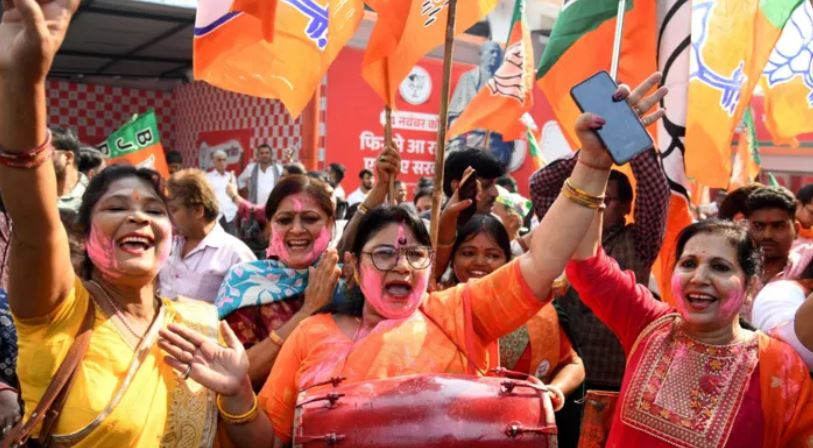
Prime Minister Narendra Modi’s Bharatiya Janata Party (BJP)–led alliance has secured a record-breaking victory in the Bihar state elections, winning 202 out of 243 seats. The election saw a historic turnout of 66.91%, the highest since 1951. The alliance between BJP and Janata Dal (United) [JD(U)], led by outgoing Chief Minister Nitish Kumar, defeated the opposition coalition of Congress, RJD, and smaller parties. Female voters played a crucial role, with women’s turnout reaching 71.6%, the highest ever in the state. Despite controversy over a revision of the voter list that removed 4.7 million names, the Election Commission and BJP denied allegations of bias. The elections were significant as they may be the last major political contest featuring veteran leaders Nitish Kumar and Lalu Prasad Yadav.
(2) Causes of events and topics or issues
Several factors contributed to the BJP-JD(U) alliance’s landslide win:
-
High female voter turnout: Welfare schemes by Nitish Kumar and promises of financial support attracted large numbers of women voters.
-
Strong organizational machinery of BJP and JD(U), along with effective campaigning across rural and urban regions.
-
Fragmentation and weakened credibility of the opposition coalition, which failed to present a unified, convincing alternative.
-
Public trust in development and welfare policies implemented by the ruling alliance.
-
Exit polls and pre-election trends that predicted a BJP-led victory strengthened public perception of momentum.
-
Controversial voter list revision, though denied as politically motivated, created political debate but did not affect the ruling coalition’s support base.
(3) Lessons to be learned from events and topics or issues
-
Voter participation—especially women’s participation—can decisively shape election outcomes. Empowering women through welfare programs and addressing their concerns leads to strong electoral engagement.
-
Stable alliances and consistent governance records play a major role in gaining public trust during elections.
-
Opposition unity is crucial in a multi-party democracy; fragmented coalitions struggle against strong, well-organized ruling alliances.
-
Transparency in electoral processes is essential to maintain public confidence, especially during sensitive tasks like revising voter lists.
-
Leadership transitions matter: With senior leaders like Nitish Kumar and Lalu Prasad Yadav nearing the end of their political careers, Bihar may see significant political shifts in the near future.